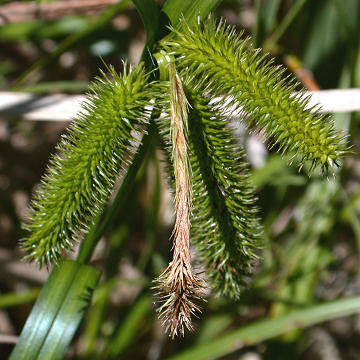
Carex comosa - (image 1 of 5)
Taxonomy
Family: Cyperaceae
Section Vesicariae
Habitat
Pond margins, ditches. Marshes.
Associates
Distribution
Quebec west to MN, south to FL and LA. Also in the west from WA to CA and northern ID.
Morphology
Perennial from a short, stout rhizome to 1 m; stems stout; lowest bracts surpassing and sometimes much longer than the inflorescence; leaves often septate-nodulose, especially the sheaths, the blade long and flat, to 9 mm wide; spikelets cylindric, pedunculate, staminate flowers on multiple, terminal spikelets to 6 cm long; pistillate scales with awns longer than the scale blades; stigmas 3; achenes trigonous; style persistent.
Notes
Fruiting May to July
Wetland indicator: OBL
This species is similar to C. hystericina Muhl. ex Willd. and C. pseudocyperus L. It can be distinguished from the latter by the teeth of the perigynia which curve outward (in C. pseudocyperus the teeth are nearly parallel).
References
Gleason, Henry A. and A. Cronquist. 1991. Manual of Vascular Plants of
Northeastern United States and Adjacent Canada. Second Ed.
The New York Botanical Garden. Bronx, NY
Swink, F. and G. Wilhelm. 1994. Plants of the Chicago Region.
Indiana Academy of Science. The Morton Arboretum. Lisle, Illinois.
|
© Michael Hough 2004 |