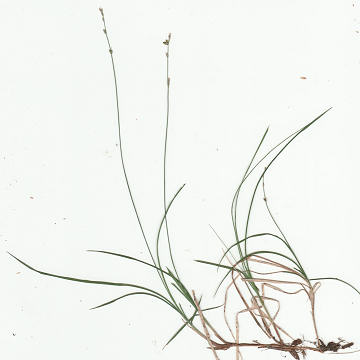
Carex disperma - (image 1 of 4)
Taxonomy
Family: Cyperaceae
Section Dispermae
Habitat
Shaded bogs, wet woods.
Associates
Distribution
Circumboreal, south to PA, IN, MN, UT, and CA.
Morphology
Stems soft, slender, to 40 cm, scattered on slender, branching rhizomes; leaves flat, to 2 mm wide; spikes 2-5, sessile, 3-6 mm; staminate flowers terminal, 1-3; perigynia 1-4; bract lacking or filiform to 2 cm; scales triangular-ovate, stramineous to white-hyaline, midrib green, typically shorter than the perigynia; perigynia ellipsoid, 2-3 mm, white-punctate, nearly round in cross-section, with 2 strong nerves at the margins, beak minute (0.2 mm); achene thick, lenticular, filling the perigynium, the style base semi-persistent as a slender apiculus.
Notes
Fruiting May to August
Wetland indicator: OBL
The specific epithet refers to the tendency for the perigynia to be borne in pairs on the spikes.
References
Gleason, Henry A. and A. Cronquist. 1991. Manual of Vascular Plants of
Northeastern United States and Adjacent Canada. Second Ed.
The New York Botanical Garden. Bronx, NY
Swink, F. and G. Wilhelm. 1994. Plants of the Chicago Region.
Indiana Academy of Science. The Morton Arboretum. Lisle, Illinois.
|
© Michael Hough 2010 |