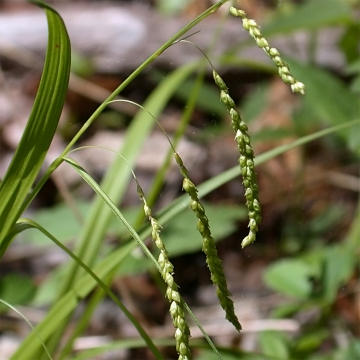
Carex gracillima - (image 1 of 5)
Taxonomy
Family: Cyperaceae
Habitat
Woods, wet-mesic swamps on old dunes.
Associates
Distribution
Newfoundland and Quebec west to Manitoba, south to VA and MO.
Morphology
Tufted, evergreen perennial to 0.9 m; stems purplish at the base; leaves 3-8 mm wide, M-shaped in cross-section; sheaths pale, mostly glabrous, often with reddish-purple dots on their front bands; terminal spike pistillate in the distal third or rarely all staminate; pistillate spikes 3-5, cylindric, 3mm wide and up to 6 cm long, erect at first but becoming spreading or nodding, on slender peduncles nearly as long as the spikes; bracts sheathing; pistillate scale ovate to obovate, half to nearly as long as the perigynia, obtuse to short-cuspidate; perigynia ellipsoid or somewhat obovoid, to 3.7 mm long, obscurely trigonous, sharply several-nerved, obtuse or rounded at the summit, beakless; achene concavely trigonous.
Notes
Fruiting late May to July.
Wetland indicator: FACU
The specific epithet refers to the graceful appearance of the spikes. The beakless perigynia distinguish this species from other slender woodland 'danglers'.
References
Curtis, L. 2006. Woodland Carex of the upper Midwest. Lake Villa, IL.
Gleason, Henry A. and A. Cronquist. 1991. Manual of Vascular Plants of
Northeastern United States and Adjacent Canada. Second Ed.
The New York Botanical Garden. Bronx, NY
Swink, F. and G. Wilhelm. 1994. Plants of the Chicago Region.
Indiana Academy of Science. The Morton Arboretum. Lisle, Illinois.
|
© Michael Hough 2009 |