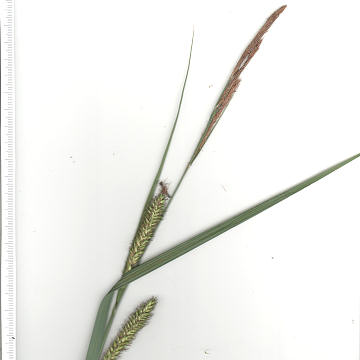
Carex lacustris - (image 1 of 6)
Taxonomy
Family: Cyperaceae
Section Paludosae
Habitat
Shores, wet woods, marshes, swamps, fens.
Associates
Distribution
Quebec to VA, west to Saskatchewan and NE.
Morphology
Rhizomatous perennial, aphyllopodic; stems stout, sharply-angled, to 1.5 m; sheaths septate-nodulose, lowest sheath bases reddish and fibrillose; ligules much longer than wide, v-shaped; main leaves blue-green, 8-15 mm wide, glaucous below, harshly scabrous margin, strong lateral nerves; terminal spikes male, 2-4; pistillate spikes dense, 2-4, 3-10 cm long, erect, sessile or on short peduncles; perigynia firm, dull green, 5-7 long and 2-3 mm wide, lance-ovoid, many nerved; scales reddish, much shorter than perigynia, ovate to oblong, abruptly awned; achene trigonous, continuous with the persistent, slender, abruptly bent or flexuous style; stigmas 3.
Notes
Fruiting May to July
Wetland indicator: OBL
The leaf margin is beset with many sharp, tiny teeth. The blue-green color of the leaves makes this species pretty easy to identify vegetatively. May hybridize with C. trichocarpa and other members of this section to form sterile clones with intermediate morphology.
References
Curtis, L. 2006. Woodland Carex of the upper Midwest. Lake Villa, IL.
Gleason, Henry A. and A. Cronquist. 1991. Manual of Vascular Plants of
Northeastern United States and Adjacent Canada. Second Ed.
The New York Botanical Garden. Bronx, NY
Swink, F. and G. Wilhelm. 1994. Plants of the Chicago Region.
Indiana Academy of Science. The Morton Arboretum. Lisle, Illinois.
|
© Michael Hough 2010 |