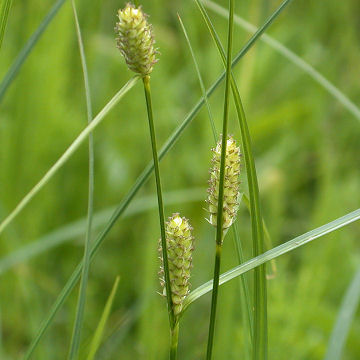
Carex pellita - (image 1 of 6)
Taxonomy
Family: Cyperaceae
Section Paludosae
The name C. lanuginosa has been misapplied to this species in the past.
Habitat
Calcareous fens and moist prairies. Marshes.
Associates
Distribution
New Brunswick and Quebec west to British Columbia, south to VA, TN, AR, and CA.
Morphology
Perennial to 1 m, forming vigorous colonies from creeping rhizomes; leaves glabrous or scabrous with a distinct midrib, mostly flat, larger blades 2-5 mm wide; terminal spikelet staminate, 2-5 cm, often subtended by one or two shorter, sessile staminate spikes; pistillate spikes two or three, 1-4 cm, sessile or the lowest one on an erect, slender peduncle; leafy bracts present, the lowest elongate, often surpassing the terminal spikes; perigynia pubescent, less than 5 mm long; stigmas 3; achenes trigonous.
Notes
Fruiting May to July.
Wetland indicator: OBL
Rare in a few states. Carex lasiocarpa Ehrh. is similar but with leaves that are folded along the midrib rather than flat.
References
Gleason, Henry A. and A. Cronquist. 1991. Manual of Vascular Plants of
Northeastern United States and Adjacent Canada. Second Ed.
The New York Botanical Garden. Bronx, NY
Swink, F. and G. Wilhelm. 1994. Plants of the Chicago Region.
Indiana Academy of Science. The Morton Arboretum. Lisle, Illinois.
USDA, NRCS. 2002. The PLANTS Database, Version 3.5 (http://plants.usda.gov).
National Plant Data Center, Baton Rouge, LA 70874-4490 USA.
|
© Michael Hough 2004 |