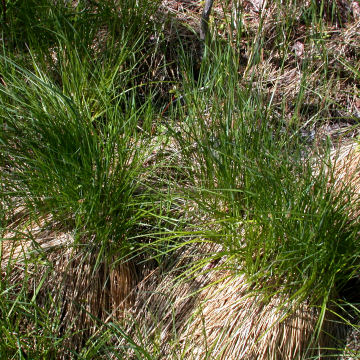
Carex stricta - (image 1 of 6)
Taxonomy
Family: Cyperaceae
Section Phacocystis
Habitat
Sedge meadows and fens. Also swales and marshes, especially on ground that is seasonally flooded.
Associates
Distribution
Quebec and Nova Scotia west to MN and Manitoba, south to VA and TX.
Morphology
Clump forming, rhizomatous perennial to 1.4 m; lowermost sheaths bladeless, tinged deep red or purple; ligule longer than the width of the blade, forming a sharp "V"; lowest bract not exceeding the inflorescence; foliage leaves 3-6 mm long, inversely "W" shaped in cross section; spikelets pedunculate; staminate spikelets terminal; staminate scales tinged purple; stigmas 2; perigynia broadest at or below the middle, more than 2.3 mm long, tapering to the tip and noticeably nerved; pistillate scales red-brown, shorter than the perigynia, acute; achenes lenticular.
Notes
Fruiting May to June.
Wetland indicator: OBL
A common tussock-forming sedge in wetlands. What has been called C. stricta encompasses forms that range from strictly clumping plants with dark green leaves to long rhizomatous plants with light green leaves that may represent more than one species or merely a high degree of phenotypic plasticity. Carex haydenii is similar but easily distinguished by its long acute or acuminate scales that surpass the perigynia.
References
Gleason, Henry A. and A. Cronquist. 1991. Manual of Vascular Plants of
Northeastern United States and Adjacent Canada. Second Ed.
The New York Botanical Garden. Bronx, NY
Swink, F. and G. Wilhelm. 1994. Plants of the Chicago Region.
Indiana Academy of Science. The Morton Arboretum. Lisle, Illinois.
|
© Michael Hough 2004 |