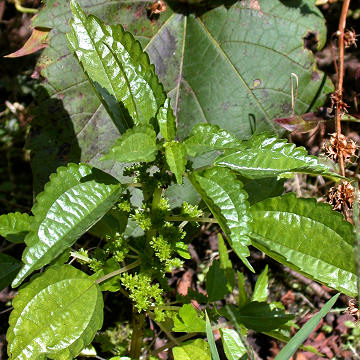
Pilea pumila - (image 1 of 5)
Taxonomy
Family: Urticaceae
Habitat
Cool, moist, shaded soil. Often forming colonies.
Associates
Range from conservative to weedy.
Distribution
Quebec west to MN, south to FL, LA, and OK.
Morphology
Monoecious or dioecious annual to 50 cm, with smooth and pellucid (translucent) stems and leaves; leaves opposite, shiny, ovate, to 12 cm, serrate to crenate-serrate, cuneate to rounded at the base on long petioles; flowers borne in cymes from the middle and upper leaf axils; calyx persistent, deeply lobed, the lobes about equal; calyx of male flowers 4-parted; stamens 4; calyx of female flowers 3-parted; stigma sessile; achenes green to yellowish, usually marked with slightly raised purple spots on the sides, 1.3-2 mm long and 55-70% as wide; seed smooth.
Notes
Flowers July to October
Wetland indicator: FACW
Very similar to Pilea fontana (Lunell) Rydb. which has mature achenes dark purple to dark olivaceous to blackish throughout and pale-margins; it also has less translucent stems and less shiny leaves.
References
Gleason, Henry A. and A. Cronquist. 1991. Manual of Vascular Plants of Northeastern United States and Adjacent Canada. Second Ed.
The New York Botanical Garden. Bronx, NY
Niering, W. A. 1979. The Audubon society field guide to North American
wildflowers: eastern region.
Knopf/Random House, New York.
Swink, F. and G. Wilhelm. 1994. Plants of the Chicago Region.
Indiana Academy of Science. The Morton Arboretum. Lisle, Illinois.
|
Michael Hough © 2009 |