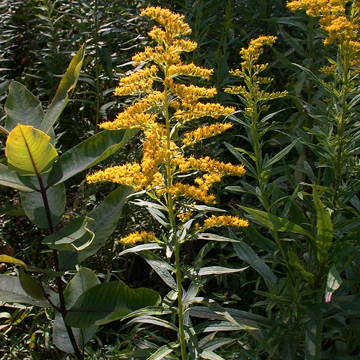
Solidago canadensis - (image 1 of 6)
Taxonomy
Family: Asteraceae
Habitat
Found in a wide range of degraded, open, or partly shaded habitats.
Associates
Distribution
Most of the U.S. and southern Canada.
Morphology
Herbaceous perennial to 2 m high; stems terete, short hairy and rough below the inflorescence; leaves tri-nerved, lowest leaves about the same size as the lower, abruptly reduced and bracteate in the inflorescence, lowest leaves usually brown and dead, not leafy in axils, subtending leaves not exceeding the inflorescence; heads in terminal panicles; flowers bright yellow; involucres 2-3 mm.
Notes
Flowers mid July to mid September
Wetland indicator: FACU
The plants pictured here are var. canadensis which has stems usually pubescent to the base and lower leaf surfaces glabrous with hairs restricted to the midrib and main veins. Plants with stems pubescent mostly above the middle and lower leaf surfaces hairy are var. hargeri. Solidago altissima is similar to var. hargeri but has involucres mostly 3-4 mm long (image 6, bottom), while S. canadensis has involucres mostly 2-3 mm long (image 6, top).
References
Gleason, Henry A. and A. Cronquist. 1991. Manual of Vascular Plants of Northeastern United States and Adjacent Canada. Second Ed.
The New York Botanical Garden. Bronx, NY
Swink, F. and G. Wilhelm. 1994. Plants of the Chicago Region.
Indiana Academy of Science. The Morton Arboretum. Lisle, Illinois.
|
Michael Hough © 2005 |