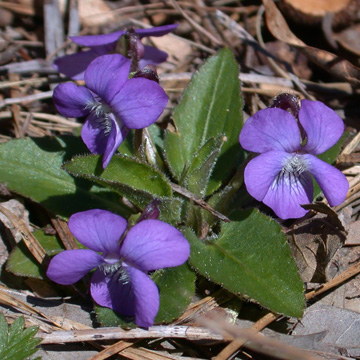
Viola sagittata - (image 1 of 5)
Taxonomy
Family: Violaceae
Habitat
Acid, sandy soil. Disturbed sandy prairies, open woods, clearings, meadows, and sometimes along streams. Often where the water table is close to the surface
Associates
Distribution
ME and Nova Scotia west to MN, south to FL and LA.
Morphology
Herbaceous perennial. Leaves all basal, glabrous or hairy; most relatively narrow, ovate or narrower, mostly at least 1.5 as long as wide, subtruncate to shallowly cordate at the base, crenate-serrate or sometimes with larger and more spreading teeth at the base or with small basal lobes. Flowers violet-purple, 2-2.5 cm wide; lower 3 petals bearded; style dilated upwards, capitate, with a conic beak on the lower side, the stigma within the top of the beak; cleistogamous flowers on erect or ascending peduncles. Fruit ovoid; seeds brown.
Notes
Flowers mid April to late June
Wetland indicator: FACW
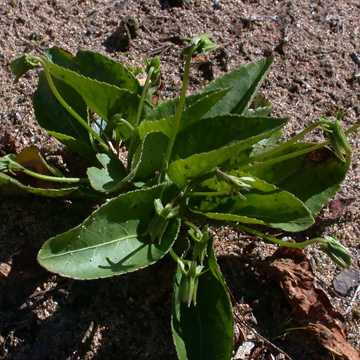
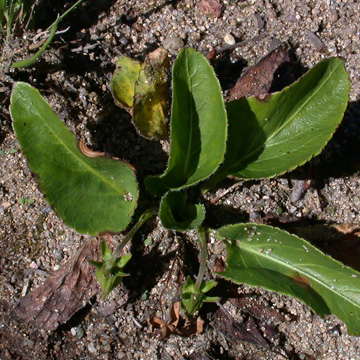
Variety ovata (=Viola fimbriatula) is more northern and has leaves that look similar to var. sagittata early in the year but the mid-season leaf blades are more truncate or somewhat cordate at the base. It also has sepals that are ciliate (vs. eciliate in var. sagittata). The following images are of var. ovata taken in northern NY in September.
References
Gleason, Henry A. and A. Cronquist. 1991. Manual of Vascular Plants of Northeastern United States and Adjacent Canada. Second Ed.
The New York Botanical Garden. Bronx, NY
Little, R.J. and
L.E. McKinney. 2015. Viola. In: Flora of North America North of
Mexico, Vol. 6. Oxford University Press, New York and Oxford.
Swink, F. and G. Wilhelm. 1994. Plants of the Chicago Region.
Indiana Academy of Science. The Morton Arboretum. Lisle, Illinois.
|
Michael Hough © 2005, 2017 |